Supine figure-4 stretch
Lie on your back with one foot supported on a wall and the knee bent. Rest the opposite ankle above that knee. Move farther from the wall for a gentler stretch; keep the back relaxed and avoid pushing on the crossed knee.


When back trouble travels into your leg.
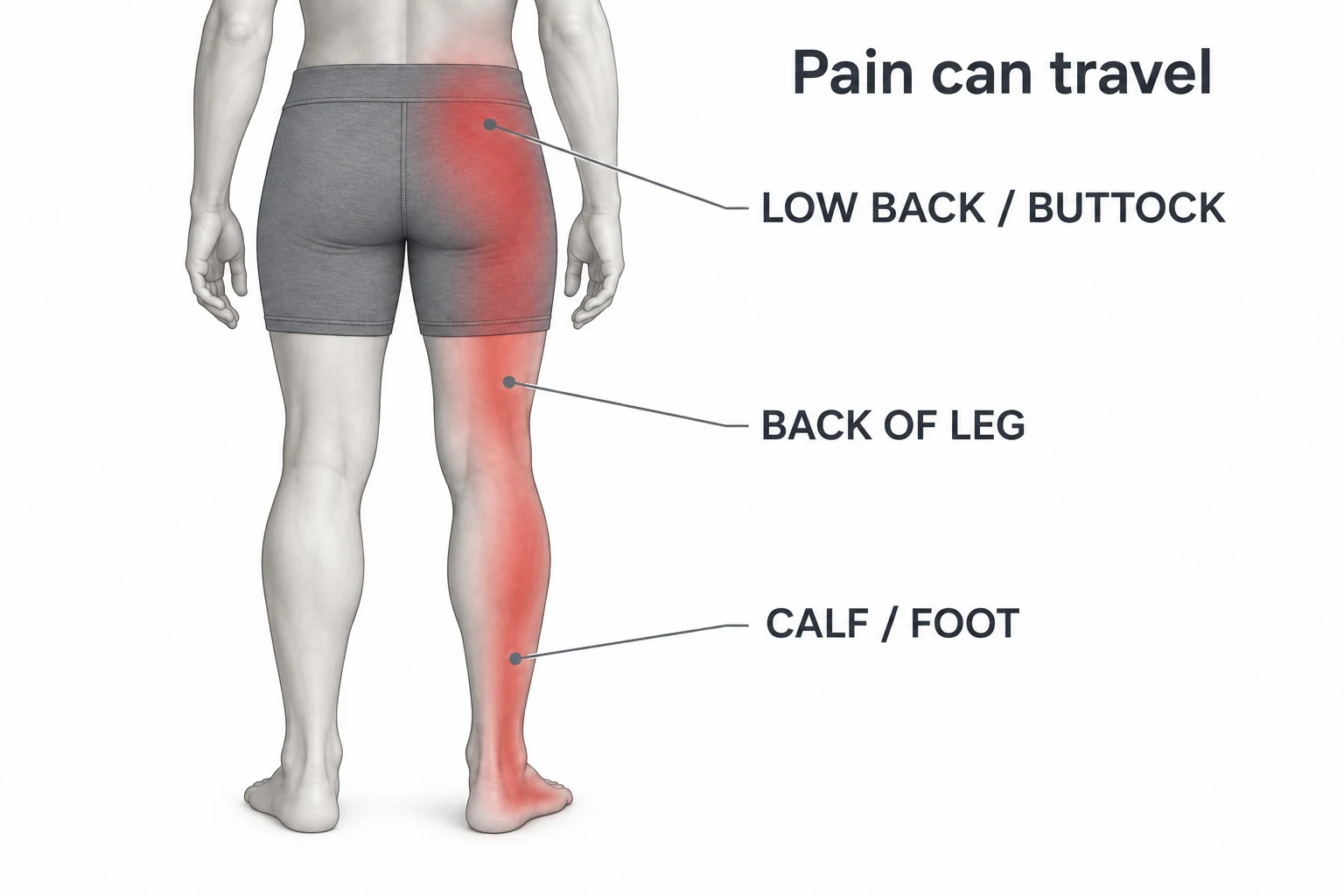
Sciatica is pain that travels from the lower back or buttock into the leg because a nerve is irritated. You may also notice tingling or numbness. The first step is understanding what is causing your symptoms and how they affect your life.
Foundations Chiropractic & Wellness · Pleasanton, CA
Sciatica commonly involves irritation or compression of a nerve root in the lower back, for example from a herniated disc or narrowing around the nerves. Other problems can also cause leg pain, so the symptom pattern alone does not establish a diagnosis. [1]
Your assessment informs how chiropractic care, soft-tissue care and exercise fit together, and whether another medical evaluation is needed.
NICE recommends considering manual therapy for low-back pain with or without sciatica as part of a package that includes exercise, tailored to the person’s needs and capabilities. It does not recommend manual therapy as a stand-alone package. [2]
A randomized trial of 220 adults with recent-onset sciatica compared education alone with education plus four weeks of physical therapy, including exercise and manual therapy. The therapy group had a modest average improvement in disability at six months. The study could not separate the effects of individual treatments, and it did not test the Foundations program. [3]
Educational draft for Dr. Nick’s review · October 2026
An easy-to-follow conversation about sciatica and the questions that matter.
Dr. Nick’s NotebookLM video will appear here when it is ready. In the meantime, explore the guide and patient handout below.
Selected for this condition, then adapted to your assessment and comfort.
Lie on your back with one foot supported on a wall and the knee bent. Rest the opposite ankle above that knee. Move farther from the wall for a gentler stretch; keep the back relaxed and avoid pushing on the crossed knee.
Sit with one leg in front and the other to the side, with both knees comfortably bent near 90 degrees. Use your hands or a cushion for support. Stay tall, ease into the position and switch sides without forcing the knees.
Kneel on a pad with the other foot in front. Gently tuck your pelvis and tighten the back-leg glute, then shift forward a little. Keep your ribs over your pelvis rather than arching your lower back.
Practical movements to support the goals you are working toward.
Lie on your back, knees bent and feet hip-width apart. Press through both feet and lift your hips to a comfortable height. Keep your back from arching, then lower slowly.
View the written exercise guide →Start on hands and knees. Reach one arm and the opposite leg away while keeping your pelvis level. Reach long rather than high, return with control, and alternate. Start with one limb at a time if needed.
View the written exercise guide →Lie on your side with your lower knee bent for support. Keep your top leg straight and your hips stacked. Lift the top leg a small distance without rolling backward, then lower slowly.
Your clinician selects the movements, repetitions and progression that fit your findings. Stop a movement that worsens leg pain, tingling or numbness.
This is the patient education section attached to your Health Report Summary when sciatica is assigned.
Sciatica is pain that travels into the leg when a nerve is irritated. Your examination helps identify the cause and guide a plan for more comfortable movement.
No. Several conditions can cause leg pain. Your history, examination and symptoms help determine the next step.
Keep moving in comfortable amounts and avoid long periods in one position. Follow the movements selected for you; do not force stretches that increase leg pain, tingling or numbness.
Seek emergency care for new numbness around the genitals or bottom, new bladder or bowel control changes, or severe or worsening weakness or numbness in both legs.

Scan for the full guide, video, stretches and exercises.
Open the full sciatica guide →myfoundationschiro.com/conditions/sciatica-pleasanton/Walking with ease. Getting through work. Returning to the activities you enjoy. Tell us what you want to get back to.
Book your assessmentChiropractic care · Massage therapy · Therapeutic exercise